Śakra in Buddhism as Indra in hinduism: Story of Sakra
When the King of Gods Became a Devotee of Enlightenment
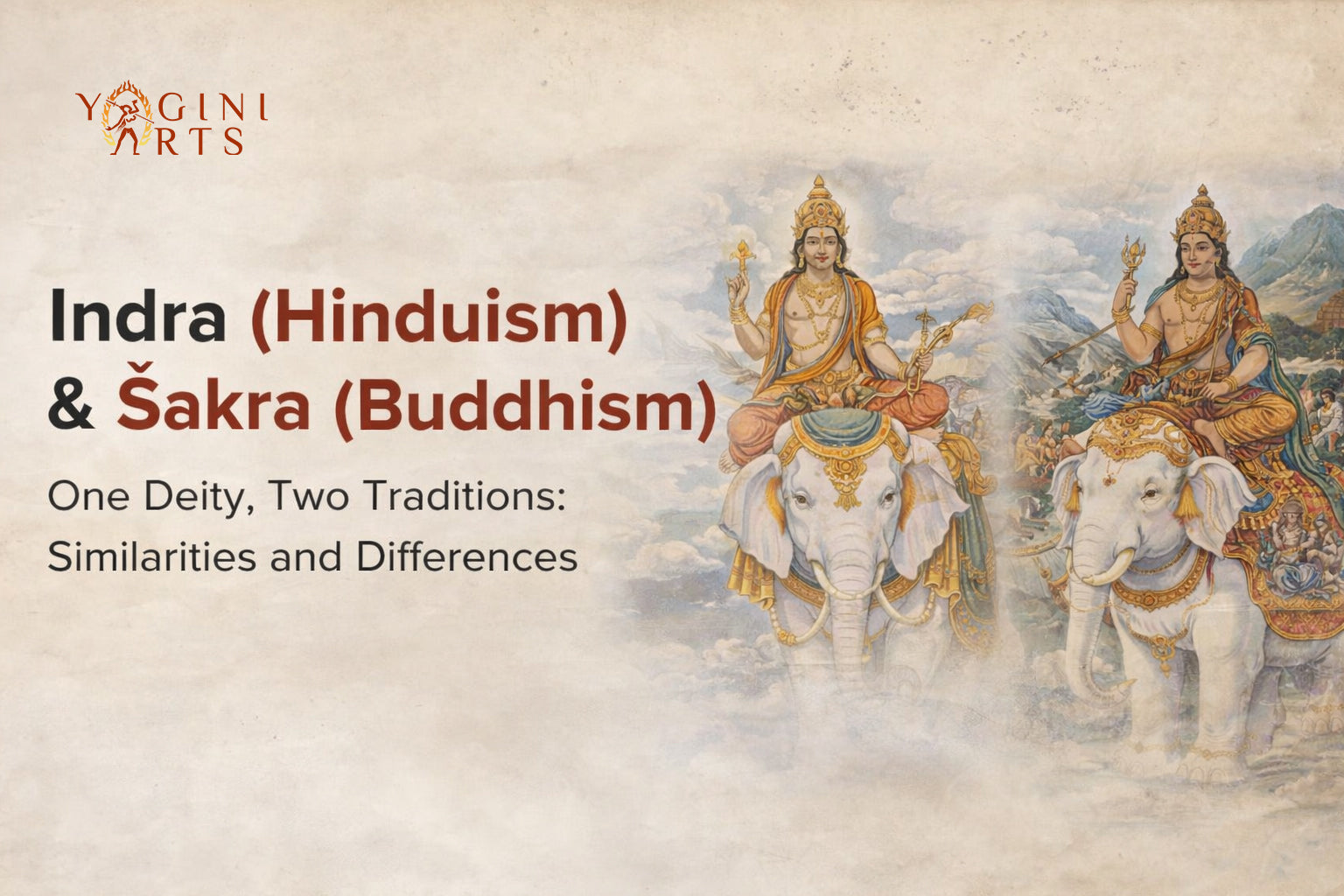
Across the vast spiritual landscapes of India and the Himalayas, one celestial figure stands at the crossroads of two great traditions. In the thunderous hymns of the Vedas, he is Indra — king of the gods, wielder of lightning, slayer of cosmic serpents. In Buddhist scriptures, he appears again, but changed. There he is Śakra — also called Śakra Devānām Indra, or Sakka in Pāli — ruler of the Thirty-Three Gods and devoted protector of the Buddha.
Are they the same being? A shared mythic inheritance? Or two theological reinterpretations of a common archetype?
The answer lies not in mythology alone, but in philosophy.
Indra in the Vedic and Hindu Tradition
In the Rigveda, Indra is among the most celebrated deities. Entire hymns are dedicated to his strength, courage, and sovereignty. He commands storms, hurls the vajra — the thunderbolt — and defeats Vṛtra, the serpent-demon who withholds the waters of life. His victory restores cosmic order. He rides the white elephant Airāvata and rules from Svarga, the celestial heaven of the Devas. In early Vedic religion, Indra is not merely powerful — he is supreme.
Core Attributes of Indra
-
King of the Devas
-
God of thunder, lightning, storms, and war
-
Wielder of the vajra
-
Slayer of Vṛtra
-
Rider of Airāvata
-
Ruler of Svarga
Yet even in Hindu tradition, time reshapes hierarchy. As classical Hinduism develops, the Trimurti — Brahma, Vishnu, and Shiva — rise in theological centrality. Indra does not disappear, but his role shifts. He remains king of heaven, sovereign of celestial beings, lord of storms and war. However, he is increasingly portrayed as fallible. He experiences jealousy, pride, desire, and fear of losing power. He intervenes in human affairs, sometimes rashly. This humanization is deliberate. Indra represents sovereignty and heroic force, but also the vulnerabilities of authority.
Śakra in Buddhist Cosmology
When Buddhism emerges within the same cultural landscape, it does not erase Indra. Instead, it reinterprets him.
In Buddhist cosmology, Indra appears as Śakra, ruler of the Trāyastriṃśa Heaven atop Mount Sumeru. He commands celestial beings and presides over divine assemblies. Yet something fundamental has changed. Śakra is not ultimate. He is powerful, but not enlightened. He possesses merit accumulated through past karma, but he remains within saṃsāra — the cycle of birth and rebirth.
Core Attributes of Śakra
-
King of the Thirty-Three Gods
-
Dwells atop Mount Sumeru
-
Protector of the Buddha and the Dharma
-
Possesses merit but is not enlightened
-
Subject to karmic rebirth
In Buddhist texts, Śakra reveres the Buddha. He descends to seek teachings. He acknowledges impermanence. He protects the Dharma. His authority is real, but it is not absolute. Heaven itself is temporary.
The Doctrinal Shift
The shift is decisive. In Hindu theology, Indra participates in divine hierarchy. In Buddhism, Śakra participates in dependent origination.
This reflects the broader doctrinal divide between the two systems. In the Vedic worldview, cosmic sovereignty carries intrinsic significance. Power, victory, and rulership reinforce divine order. In Buddhist thought, power without enlightenment remains incomplete. Status does not equal liberation. Heaven does not equal Nirvana.
The Symbolism of the Vajra
The vajra, once Indra’s thunderbolt weapon, illustrates this transformation vividly. In Hinduism, it is a literal instrument of atmospheric force. In Buddhism — particularly in Vajrayāna — it becomes a symbol of indestructible wisdom, representing insight that cuts through ignorance. The weapon of a storm god becomes the emblem of awakening.
Continuity Beneath Transformation
Yet continuity remains unmistakable. Both Indra and Śakra rule celestial realms. Both reside atop Mount Meru or Sumeru, the cosmic axis. Both command assemblies of devas. Śakra is not an invention; he is a reframing.
Buddhism does not deny the existence of gods. It situates them within a moral and karmic framework. Even the king of the gods is impermanent. Even the highest heaven is subject to decay. Even celestial authority bows before enlightenment.
Religious Dialogue and Reinterpretation
The Indra–Śakra transformation demonstrates a remarkable religious dialogue. Buddhism engages the Vedic pantheon using familiar names and imagery, but subtly shifts the metaphysical center. Divine kingship becomes subordinate to awakening. Sovereignty becomes secondary to wisdom.
Conclusion: Same Name, Different Destiny
Indra commands the heavens.
Śakra bows to the Buddha.
They share mythic DNA, but they serve different metaphysical systems. One embodies atmospheric power and heroic kingship. The other embodies celestial authority humbled before the truth of impermanence.
And in that bow — that gesture of reverence from a king to an awakened teacher — lies the most profound difference between Hindu and Buddhist theology.