Article: How a Traditional Thangka Painting Is Made: From Sacred Sketch to Masterpiece
How a Traditional Thangka Painting Is Made: From Sacred Sketch to Masterpiece
How a Thangka Is Made: A Step-by-Step Journey from Sketch to Sacred Art

Thangka painting is one of the most revered artistic traditions of Tibetan Buddhism. Every authentic handmade Thangka undergoes a meticulous process that combines sacred geometry, artistic mastery, meditation, and symbolism. The creation of a traditional Thangka can take weeks or even months depending on its complexity and level of detail.
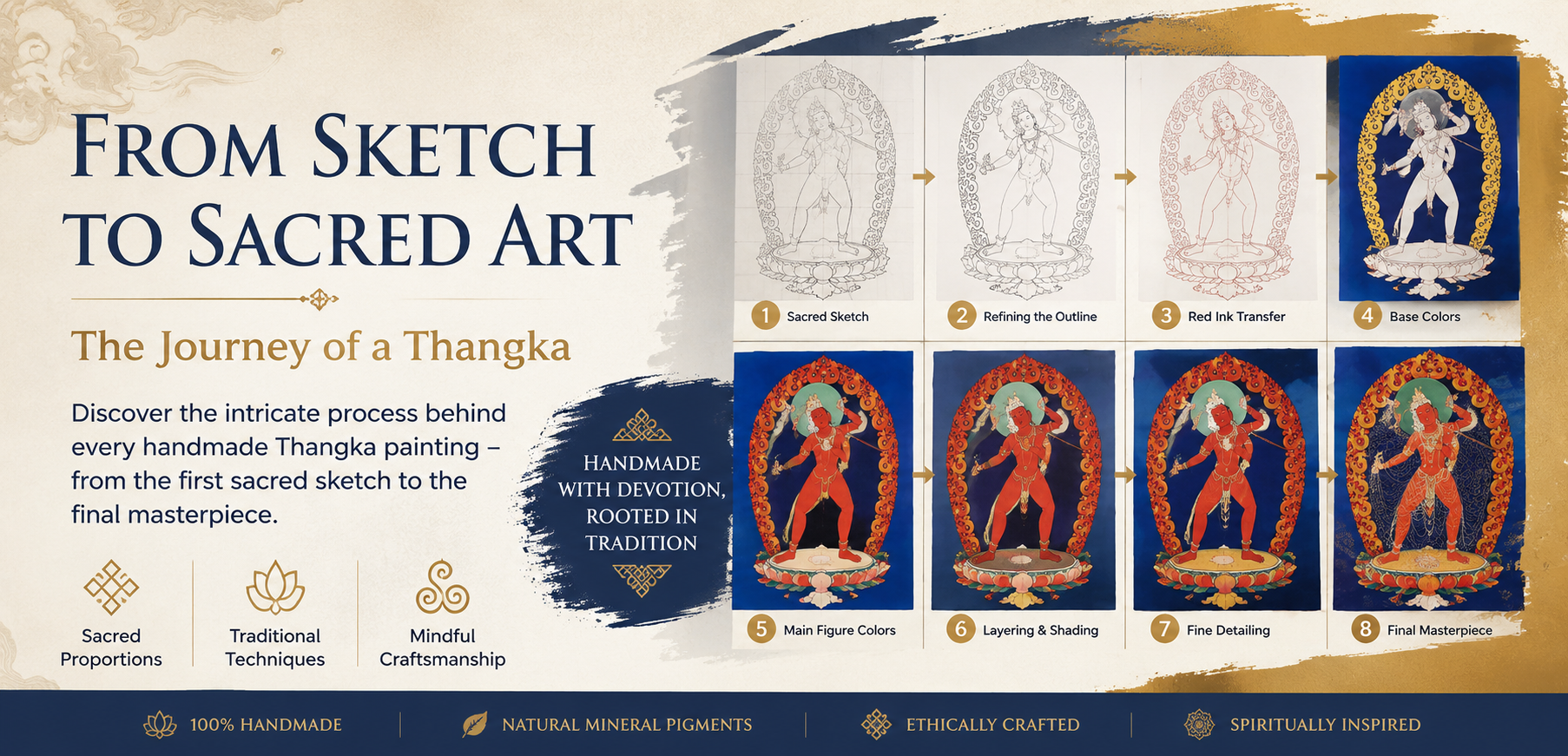
The image above beautifully illustrates the complete evolution of a Thangka painting—from the initial sketch to the finished masterpiece. Let's explore each stage in detail.
What Is a Thangka Painting?
A Thangka is a traditional Tibetan Buddhist scroll painting created on cotton or silk canvas. These sacred artworks depict Buddhas, Bodhisattvas, Deities, Mandalas, Protectors, and enlightened beings. More than decorative art, a Thangka serves as a meditation aid, teaching tool, and spiritual object.
Every element within a Thangka follows strict iconographic guidelines passed down through generations of master artists.
Stage 1: Sacred Proportional Sketching
The Foundation of Every Thangka

The first panel in the image shows the artist creating a light pencil sketch using geometric guidelines and sacred proportions.
Before any painting begins, the artist carefully draws:
- The deity's posture
- Hand gestures (Mudras)
- Facial features
- Body proportions
- Sacred ornaments
- Lotus throne
- Halo and aureole
Traditional Thangka artists use precise mathematical ratios prescribed by Buddhist scriptures. These measurements ensure the deity is represented correctly according to spiritual teachings.
At this stage:
✓ The canvas is prepared and stretched.
✓ Sacred grids are drawn.
✓ Major compositional elements are positioned.
✓ Symmetry and balance are checked.
This stage forms the spiritual and structural blueprint of the entire artwork.
Stage 2: Refining the Line Drawing
The second panel reveals a cleaner and more defined version of the sketch.
Adding Detailed Outlines

Once the primary structure is approved, the artist strengthens the line work and begins adding:
- Facial details
- Jewelry outlines
- Floral decorations
- Sacred symbols
- Lotus petals
- Decorative aureole patterns
Every curve and ornament is carefully refined.
At this point the composition is fully established, although no color has been added yet.
The artist ensures that:
- The deity's expression conveys the correct spiritual quality.
- The body proportions remain accurate.
- Symbolic elements are correctly placed.
This stage requires patience because mistakes in the drawing will affect all later painting stages.
Stage 3: Red Ink Transfer and Final Drawing
In the third panel, the finalized drawing is transferred into a clean red outline.
Preparing for Color Application

Many traditional artists redraw important contours using red pigment or red ink.
This serves several purposes:
- Clarifies final outlines
- Separates construction lines from finished lines
- Creates a guide for coloring
- Helps maintain precision during painting
At this stage:
- Decorative motifs are finalized.
- Halo patterns are completed.
- Lotus throne details are refined.
The painting now has a complete and permanent framework.
Stage 4: Applying Base Colors
The fourth panel introduces the first major color application.
Building the Color Foundation

Large areas are filled with flat base colors.
Notice how:
- The background becomes deep blue.
- The decorative halo turns gold.
- The figure remains mostly unpainted.
Traditional Thangka artists work from larger areas toward finer details.
Common pigments traditionally include:
- Natural mineral pigments
- Ground gemstones
- Gold powder
- Plant-based colors
Today, many artists also use high-quality modern mineral pigments while preserving traditional techniques.
The purpose of this stage is to establish the overall color harmony of the Thangka.
Stage 5: Coloring the Main Figure
The fifth panel shows the deity receiving its primary body color.
Bringing the Deity to Life

Once the background is established, the artist begins painting:
- Skin tones
- Lotus base
- Symbolic objects
- Supporting figures
In this example, the deity's body is painted in a vivid red hue, symbolizing specific enlightened qualities within Vajrayana Buddhism.
The artist carefully maintains clean edges and balanced color relationships throughout the composition.
Stage 6: Layering and Shading
The sixth panel demonstrates increasing depth and dimensionality.
Developing Form Through Gradients

Traditional Thangka painting relies on delicate color transitions rather than heavy brushstrokes.
Artists begin adding:
- Highlights
- Mid-tones
- Shadows
- Decorative textures
- Floral colors
This process creates:
- Volume in the body
- Depth in garments
- Realistic lotus petals
- Dimensional jewelry
The painting begins transforming from a flat design into a vibrant sacred image.
Stage 7: Fine Detailing and Ornamentation
The seventh panel reveals significant progress in decorative elements.
Adding Sacred Jewelry and Details

This is one of the most time-consuming stages.
Artists carefully paint:
- Necklaces
- Bracelets
- Crowns
- Gemstones
- Sacred ornaments
- Floral decorations
Each tiny element is individually shaded and highlighted.
Traditional Thangka masters may spend many days completing the jewelry alone.
This stage enhances:
- Spiritual symbolism
- Visual richness
- Sacred iconography
- Artistic elegance
Stage 8: Final Highlights and Completion
The final panel showcases the completed Thangka.
The Masterpiece Emerges

The last stage involves:
- Gold detailing
- Fine white highlights
- Energy lines
- Facial refinements
- Decorative finishing work
Notice the intricate white jewelry patterns and radiant detailing surrounding the deity.
The artist carefully paints the eyes and facial features near the end of the process. In many traditions, the "Opening of the Eyes" ceremony symbolizes the completion of the sacred image.
The finished Thangka is now ready for:
- Meditation practice
- Shrine installation
- Temple display
- Spiritual offerings
- Art collection
Materials Used in Traditional Thangka Painting
Authentic handmade Thangkas are created using:
Canvas
- Cotton canvas
- Silk canvas
Pigments
- Mineral pigments
- Natural stone pigments
- Organic colors
Precious Materials
- 24K gold
- Gold powder
- Gold leaf
Tools
- Handmade brushes
- Bamboo tools
- Fine detailing brushes
Why Handmade Thangkas Are Valuable
Every authentic Thangka represents:
- Hundreds of hours of skilled craftsmanship
- Sacred Buddhist knowledge
- Traditional artistic training
- Cultural heritage preservation
- Spiritual symbolism
Unlike mass-produced prints, a handmade Thangka is a unique work of sacred art created according to centuries-old traditions.
How to Identify an Authentic Handmade Thangka
When purchasing a Thangka, look for:
✓ Hand-painted details
✓ Fine brushwork
✓ Traditional iconography
✓ Genuine gold detailing
✓ Natural color layering
✓ Accurate proportions
✓ Artisan craftsmanship
Authentic Thangka paintings often reveal subtle brushstrokes and intricate details that cannot be replicated by machine printing.
Shop Authentic Handmade Thangka Paintings
If you are looking for a genuine Tibetan Thangka, choose artwork created by trained master artists who follow traditional methods and iconographic standards.
Our collection features:
- Handmade Tibetan Thangkas
- Buddhist Deity Paintings
- Mandala Thangkas
- Green Tara Thangkas
- White Tara Thangkas
- Medicine Buddha Thangkas
- Vajrayogini Thangkas
- Gold Thangka Paintings
- Custom Commissioned Thangkas
Each piece is crafted using traditional techniques similar to the process shown above, preserving the sacred heritage of Himalayan Buddhist art.