Wrathful Compassion: Who Is Mahakala?
In the world of Tibetan Buddhism, not all compassion appears gentle.
Some forms of compassion roar.
Some burn.
Some terrify.
Among the most powerful of these forms stands Mahakala — a wrathful deity whose dark presence, flaming aura, and fierce expression seem, at first glance, almost frightening. Yet this intensity is not anger in the ordinary sense. It is precision. It is protection.
Mahakala is not a god of destruction.
He is a guardian of awakening.
Why Wrathful Deities Look Fierce
To understand Mahakala, one must first understand why wrathful deities appear so terrifying.
In Vajrayāna Buddhism, enlightenment is not always approached through calm and serenity. The mind resists transformation. Ego clings. Ignorance persists. In such cases, compassion must take a more forceful form.
Wrathful deities embody that force.
Their fierce expressions, bulging eyes, and dynamic postures are not directed at beings, but at:
-
Delusion
-
Attachment
-
Spiritual obstacles
-
Negative forces that obstruct the path
This is wrathful compassion — compassion that does not negotiate with ignorance, but cuts through it.
Mahakala's terrifying form is meant to awaken, not to frighten.
Who Is Mahakala?
Mahakala is one of the most important Dharmapalas, or protectors of the Dharma, in Tibetan Buddhism. He is often understood as a wrathful manifestation of Avalokiteśvara, the Bodhisattva of Compassion.
This connection defines his nature.
Mahakala is not separate from compassion — he is compassion in its most uncompromising form.
Across different Buddhist lineages, Mahakala appears in multiple manifestations, each with distinct iconographic and ritual significance. Yet all share the same essential role: to protect the teachings and remove obstacles on the path to enlightenment.
The Skull Crown: Transformation of the Five Poisons
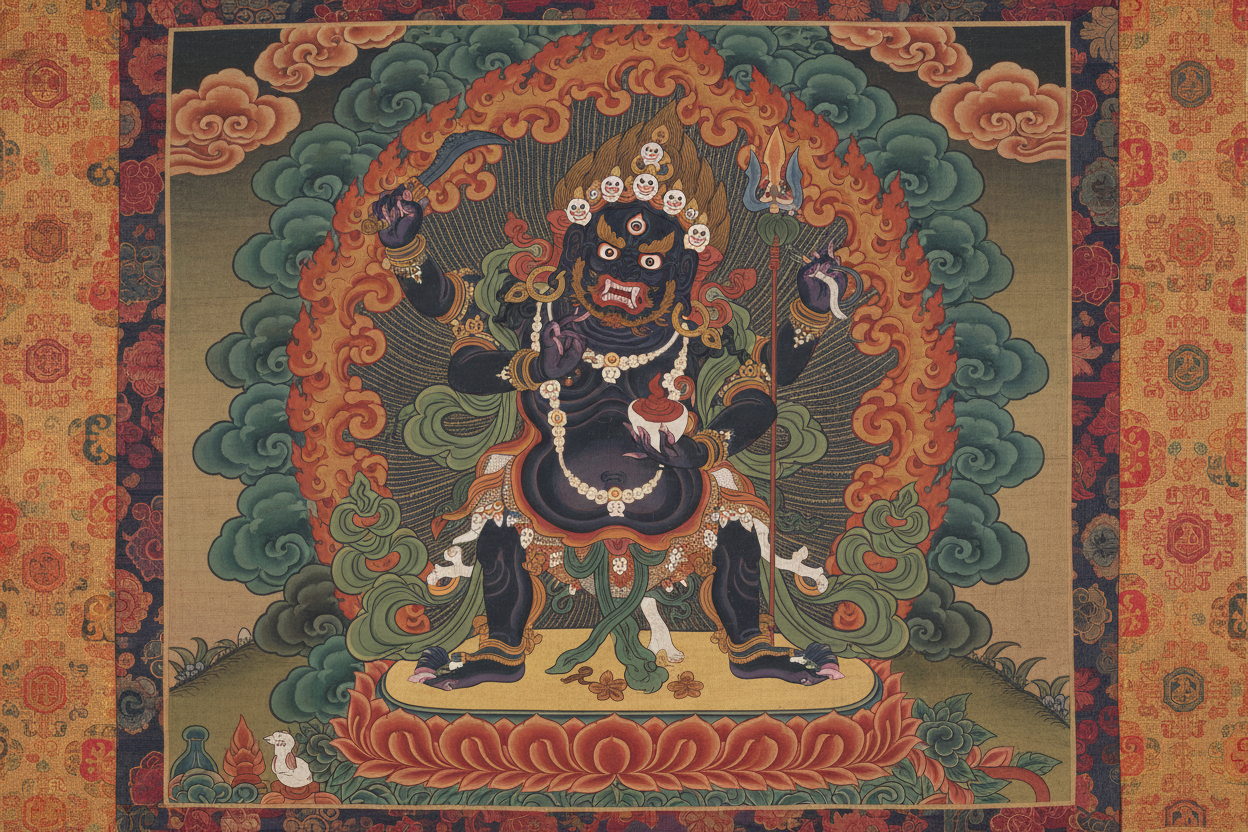
One of Mahakala’s most striking features is the crown of five skulls that rests upon his head.
This is not a symbol of death in a literal sense.
It represents transformation.
The five skulls symbolize the transformation of the five poisons:
-
Ignorance
-
Attachment
-
Anger
-
Pride
-
Jealousy
In Mahakala’s form, these poisons are not suppressed — they are transmuted into wisdom.
The crown signifies mastery over the very forces that bind beings to suffering.
The Fire Halo: Wisdom as Flame
Mahakala is almost always depicted surrounded by a blazing halo of fire.
This is not ordinary fire.
It is wisdom fire — the fire that burns away ignorance, illusion, and karmic obscurations.
The flames represent:
-
Purification
-
Transformation
-
The intensity of awakened awareness
Rather than destroying indiscriminately, this fire refines. It consumes only what obstructs clarity.
Within this fire, Mahakala stands unmoved.
Protector Role in Monasteries
Mahakala’s presence is not confined to imagery alone. He plays a central role in the living practice of Tibetan Buddhism.
In monasteries, Mahakala is invoked as a protector of:
-
The Dharma (teachings)
-
Monastic institutions
-
Ritual practices
-
Practitioners on the spiritual path
Before major ceremonies, rituals dedicated to Mahakala are often performed to remove obstacles and ensure spiritual integrity.
His role is active, not symbolic.
He is called upon to guard the path itself.
Different Forms of Mahakala
Mahakala does not appear in a single fixed form. His manifestations vary across traditions, each emphasizing different aspects of his protective function.
Among the most prominent forms are:
-
Four-Armed Mahakala, often associated with general protection and removal of obstacles
-
Six-Armed Mahakala, linked to Avalokiteśvara and the active defense of compassion
-
Bernagchen (Black Cloak Mahakala), a key protector in the Kagyu tradition
Despite these variations, all forms share core elements: wrathful expression, dynamic posture, symbolic implements, and a fierce commitment to protecting the Dharma.
Reading a Mahakala Thangka
To encounter a Mahakala Thangka is to confront intensity.
The skull crown, the flames, the weapons, the dark form — none of these are decorative. Each element communicates a precise philosophical message.
Mahakala’s image teaches:
-
Compassion can be fierce
-
Protection requires strength
-
Transformation is not always gentle
-
Enlightenment demands the removal of obstacles
What appears terrifying at first reveals itself, upon understanding, as deeply compassionate.
Conclusion: The Fierce Face of Compassion
Mahakala stands at the edge of perception — where fear transforms into insight.
To the untrained eye, he is overwhelming.
To the practitioner, he is reassuring.
Because his presence means that the path is protected.
Wrathful, vigilant, and unwavering, Mahakala embodies a truth central to Vajrayāna Buddhism:
Compassion is not always soft.
Sometimes, it burns.
And in that fire, ignorance has nowhere left to hide.